
For designersFor clients
Straight, semi-concealed or concealed edge — how much of the grid you see on the ceiling
Three types of ceiling-tile edge, the calculated share of visible grid per square metre, and two things that only come up on site: tiles cut at the wall and access above the ceiling.
For investors and clients: how to choose a tile edge so the ceiling looks like the visualisation and can still be opened up when needed.
A suspended ceiling tile can rest on the grid in three ways, and that choice matters more than colour or texture. The same material, the same module and the same absorption class produce a completely different ceiling depending on whether you see a grid of white strips or only narrow joints between the tiles.
Every manufacturer uses its own designations — in the Ecophon systems we install most often, that means the letters A, E and D with suffixes (Ds, Dt, Dg). In practice, every edge boils down to one of three types. Straight (A): the tile rests on a visible profile and sits flush with it. Semi-concealed (E): the edge has a recessed step, so the tile face drops a few millimetres below the profile and the grid hides in the shadow. Concealed (D): the profile sits inside a slot cut into the thickness of the tile and is invisible from below.
Below: a table of the three types, a calculation of visible grid worth doing before you choose, and two things that only surface once installation starts.
Three edges — in cross-section and in the table
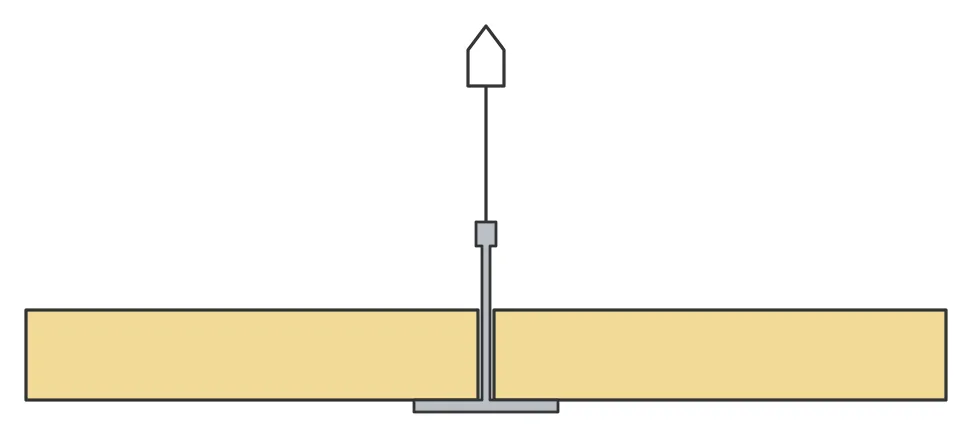
Straight edge · Advantage A
The full profile strip is visible from below.
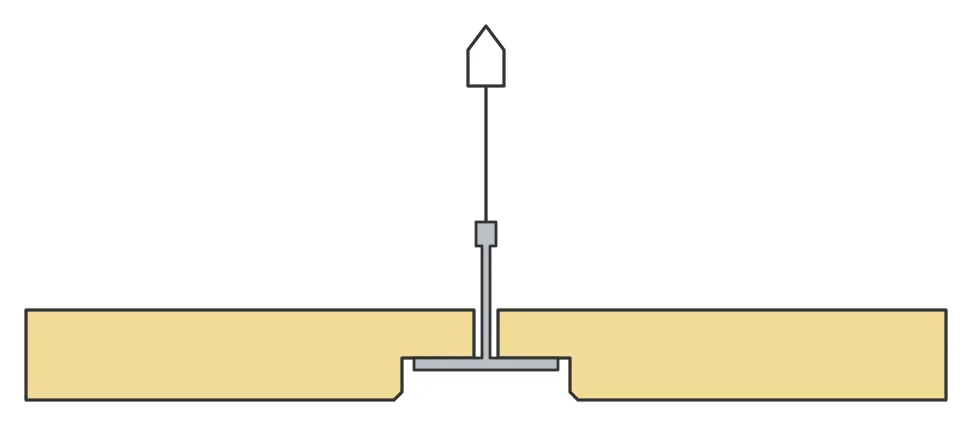
Semi-concealed edge · Master E
The profile sits back behind the tile face — a shadow line from below.
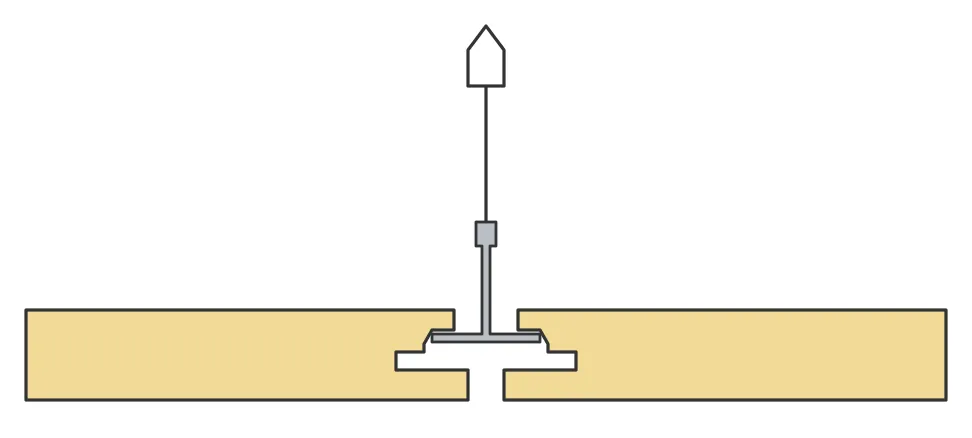
Concealed edge · Focus Ds / Dg
The profile is hidden inside the tile — only the joint shows from below.
Przewiń w poziomie, aby zobaczyć wszystkie kolumny
Three things worth checking before you choose
How much grid you will see — you can calculate it
On a 600 × 600 module, the profiles run every 0.6 m in both directions, so every square metre carries 3.33 m of grid. With a 24 mm flange (T24) that is 0.08 m² of metal per square metre of ceiling, with 15 mm (T15) it is 0.05 m². On a 1200 × 600 module there is a quarter less grid: 2.5 m per square metre. A surprising conclusion: a straight edge on T15 in a 1200 × 600 module shows 3.75% metal — over half as much as the same edge on T24 in a 600 × 600 module. A calm-looking ceiling doesn’t always need a concealed system — sometimes a narrower profile and a larger tile is enough.
Tiles cut at the wall
Cut tiles almost always end up along the walls. With the straight edge that is no problem: the cut edge looks factory-made and rests on the wall angle. With the semi-concealed edge, cutting removes the step, so it has to be re-cut into every trimmed tile on site — otherwise the tiles at the wall hang higher than the rest and the ceiling perimeter looks untidy. That is extra work worth including in the quote, and the first thing checked at handover.
Access to services above the ceiling
Cables, ventilation, sensors and fire dampers run above the ceiling, and service staff need to reach them. The straight and semi-concealed edges impose no conditions here — you simply lift any tile. With the concealed edge you need to ask about the specific system: Ecophon Focus Ds lets you remove any tile from below, but not every concealed-grid ceiling allows that — in some, access is only through access tiles at positions planned in advance. In a services corridor or a server room, that difference matters more than looks.
To paste into your request for quotation
Three sentences that make two quotes describe the same ceiling.
Modular ceiling, tile edge ____ (straight A / semi-concealed E / concealed), module ____ × ____ mm, grid ____ (T24 / T15) in colour ____.
Wall-line tiles cut with the edge profile re-formed according to the system manufacturer’s instructions; wall angle ____.
Access to the space above the ceiling: removal of any tile from below without tools / through access tiles at the positions shown on the drawing.
Najczęściej zadawane pytania
Does the edge type change the ceiling’s acoustics?
Only slightly. Absorption is decided by the tile material, its thickness and the space above the ceiling, not by the shape of the edge. The technical data sheet states the class for a specific product and installation method, so when comparing quotes it is enough to check that the values refer to the same tile and the same cavity depth.
Which edge is the cheapest?
The straight edge. The tile needs no milled step, installation is the fastest, and there is no extra work at the walls. The semi-concealed edge costs more because of edge machining and wall trimming; the concealed edge costs the most, since it adds a separate grid and more precise installation. Exact pricing depends on the chosen system, so it is best to compare quotes described with the same parameters.
Can tiles with a different edge be fitted onto an existing grid?
Between straight and semi-concealed — often yes, since in many systems both sit on the same T24 or T15 grid. You only need to check that the new tile is designed for that profile. Switching to the concealed edge means replacing the whole grid, because the profile has a completely different shape.
Does the grid have to be white?
No. Profiles are also produced in black and other colours. With the straight edge, the grid colour decides the whole ceiling’s character: a white grid under white tiles almost disappears, a black one draws a clear pattern. With the semi-concealed edge, a dark grid also deepens the shadow between the tiles.
Sources
- Ecophon — Focus range: edges A, E, Ds, Dt, Dg and their properties(otwiera się w nowej karcie)
- Ecophon — Focus A: visible grid, easy tile removal(otwiera się w nowej karcie)
- Ecophon — Focus E: semi-concealed grid and stepped edges(otwiera się w nowej karcie)
- Ecophon — Focus Ds: concealed grid with tiles removable from below(otwiera się w nowej karcie)